- Identification
- Properties
- Safety Data
- Specifications & Other Information
- Links
- Quick Inquiry
Identification
CAS Number
97239-80-0
Name
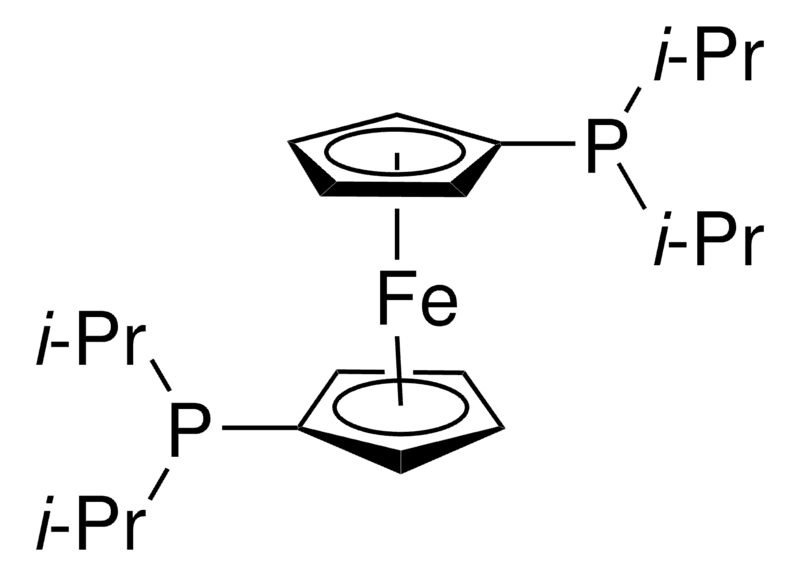
1,1'-Bis(di-i-propylphosphino)ferrocene
Synonyms
1,1′-Bis(diisopropylphosphino)ferrocene1,2,3,4,5-Cyclopentanepentayl, 1--, iron salt (2:1)1-(Diisopropylphosphino)-1,2,3,4,5-cyclopentanepentayl - fer (2:1)1-(Diisopropylphosphino)-1,2,3,4,5-cyclopentanepentayl - iron (2:1)1-(Diisopropylphosphino)-1,2,3,4,5-cyclopentanpentayl -eisen (2:1)97239-80-0MFCD02684559
SMILES
CC(C)P(11)C(C)C.CC(C)P(11)C(C)C.
StdInChI
InChI=1S/2C11H23P.Fe/c21-9(2)12(10(3)4)11-7-5-6-8-11;/h29-11H,5-8H2,1-4H3;
StdInChIKey
XUUUHBFNNJSDAR-UHFFFAOYSA-N
Molecular Formula
C22H36FeP2
Molecular Weight
418.323
MDL Number
MFCD02684559
Properties
Appearance
Orange yellow powder
Melting Point
50-52 °C
Safety Data
RIDADR
NONH for all modes of transport
WGK Germany
3
Specifications and Other Information of Our 1,1'-Bis(di-i-propylphosphino)ferrocene CAS 97239-80-0
Identification Methods
HNMR, HPLC
Purity
98% min
Shelf Life
2 years
Storage
Under room temperature away from light
Known Application
- Homogeneous catalyst ligandDiPPF is widely used in homogeneous catalytic reactions, especially in transition metal catalytic reactions, such as palladium-catalyzed cross-coupling reactions (such as Suzuki, Heck, Stille and Sonogashira reactions). Its diphosphine ligand structure can effectively stabilize transition metal centers such as palladium, rhodium and nickel, thereby improving the activity and selectivity of the catalyst. Due to its steric hindrance and electronic effects, DiPPF can significantly improve the yield and efficiency of catalytic reactions and has important applications in the synthesis of complex organic molecules.
- Drug synthesisIn pharmaceutical chemistry, 1,1'-bis(diisopropylphosphino)ferrocene can be used as a catalyst ligand to synthesize biologically active drug molecules. Its catalytic system helps to reduce side reactions and improve the selectivity of target products, which is of great significance in the development of new drugs.
- Fine chemical synthesisDiPPF is widely used in the synthesis of fine chemicals, fragrances and agricultural chemicals, especially chemical reactions that require high selectivity and high efficiency. Due to its significant promotion of palladium-catalyzed coupling reactions, various complex aromatic and olefin compounds can be synthesized.
- Materials ScienceIn materials science, DiPPF can be used to synthesize organic electronic materials and functional polymers, such as materials for organic light-emitting diodes (OLEDs) and organic photovoltaic cells (OPVs). Its ligand effect helps to regulate the electronic properties of metal centers, thereby improving the optoelectronic properties of materials.
- Academic ResearchIn academic research, 1,1'-bis(diisopropylphosphino)ferrocene is widely used as a model ligand to study metal-ligand interactions, catalytic reaction mechanisms, and the development of new catalytic systems. It is used as a tool in coordination chemistry to study different metal complexes and to explore the structure-activity relationship of catalysts.
General View of Documents
Links
This product is developed by our R&D company Warshel Chemical Ltd (https://www.warshel.com/).
Quick Inquiry
Fill out our inquiry form and one of our experts will be in touch with you shortly. https://www.watson-int.com/11-bisdi-i-propylphosphinoferrocene-cas-97239-80-0/
Comments
Post a Comment