- Identification
- Properties
- Safety Data
- Specifications & Other Information
- Links
- Quick Inquiry
Identification
CAS Number
23761-23-1
Name
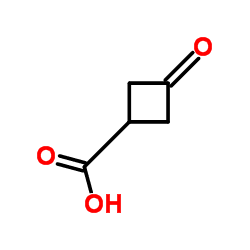
3-oxocyclobutanecarboxylic acid
Synonyms
2078401 23761-23-1 3-Oxocyclobutancarbonsäure 3-Oxocyclobutane-1-carboxylic acid 3-Oxocyclobutanecarboxylic acid Acide 3-oxocyclobutanecarboxylique Cyclobutanecarboxylic acid, 3-oxo- L4VTJ CVQ (3-Oxocyclobutyl)carboxylic acid 1-Carboxy-3-oxocyclobutane2-Ethylsulfonylethanol3-oxocyclobutanecarboxylic acid3-ketocyclobutanecarboxylic acid3-Oxocyclobutane-1-carboxylic acid|1-Carboxy-3-oxocyclobutane95%AC1NKHBVAGN-PC-0LJAYCBR-25641cyclobutanone-3-carboxylic acidMFCD00100900 OS-7697PS-5042PubChem14220
SMILES
C1C(CC1=O)C(=O)O
StdInChI
InChI=1S/C5H6O3/c6-4-1-3(2-4)5(7)8/h3H,1-2H2,(H,7,8)
StdInChIKey
IENOFRJPUPTEMI-UHFFFAOYSA-N
Molecular Formula
C5H6O3
Molecular Weight
114.099
MDL Number
MFCD00100900
Properties
Appearance
Off-white solid
Safety Data
Symbol
GHS07
Signal Word
Warning
Hazard statements
H315, H319, H335
Precautionary Statements
P261, P271, P280, P301, P301, P302, P304, P305, P312, P313, P332, P337, P338, P340, P351, P352
WGK Germany
3
MSDS Download
Specifications and Other Information of Our
Identification Methods
HNMR, GC
Purity
98% min
K.F
≤1.0%
Shelf Life
2 years
Storage
Under room temperature away from light
Known Application
3-Oxocyclobutanecarboxylic acid is a very important pharmaceutical intermediate. It is widely used in the synthesis of dozens of APIs, such as ACK1 antibodies, MDM2 antagonists, JAK inhibitors, CETP inhibitors, kinase inhibitors, PDE10 inhibitors, thrombin inhibitors, and in autoimmune chronic inflammation and anti-tumor drugs. In the pharmaceutical field, it is often used in the following aspects:
1. Synthesis of antibiotics and antiviral drugs: As an intermediate containing a ring structure, it can be used to synthesize compounds with antibacterial or antiviral activity. Its ring structure can improve the biological activity and cell membrane permeability of the molecule in some cases, thereby enhancing the efficacy.
2. Synthesis of unnatural amino acids: 3-Oxocyclobutanecarboxylic acid is often used to synthesize unnatural amino acids. These special amino acids are used to develop peptide drugs, which helps to improve the stability, selectivity and metabolic half-life of the drug.
3. Anticancer drug development: Due to its unique molecular structure, 3-Oxocyclobutanecarboxylic acid is used as a key skeleton in the design of some anticancer drugs. Its ring structure can help drug molecules bind to specific protein targets, helping to inhibit the proliferation of cancer cells.
4. Synthesis of enzyme inhibitors: 3-Oxocyclobutanecarboxylic acid can be used as an intermediate for synthesizing enzyme inhibitors to help design drugs for regulating the activity of biological enzymes. Such drugs have potential in the treatment of metabolic diseases and neurodegenerative diseases such as Alzheimer's disease.
5. Other drug molecular modifications: It can also be used to introduce cyclobutane structures into existing drug molecules to optimize pharmacokinetic properties, such as increasing bioavailability or reducing toxicity.
It has some potential application values in the field of polymer materials and polymers, including the following aspects:
1. Cross-linking agent or chain transfer agent: Its cyclobutane structure helps to introduce reactive sites into the polymer system, which is used to adjust the molecular weight and chain structure of the polymer chain, thereby optimizing the mechanical properties, thermal stability and solvent resistance of the material. As a cross-linking agent, it can help form a three-dimensional network structure, thereby enhancing the strength and heat resistance of the polymer.
2. Polymer modifier: 3-Oxocyclobutanecarboxylic acid can be used to modify existing polymer materials to improve their performance. For example, introducing it into polyamide, polyester or polyurethane can improve the toughness, wear resistance and chemical resistance of the material, while its ring structure helps to improve the rigidity of the material.
3. Precursor of photosensitive polymers: Its ring structure and carbonyl group can be used as precursors of photosensitive polymers, and ring cleavage reactions can be induced by light or heat treatment to achieve specific functions. The polymers prepared in this way can be used in fields such as lithography and microelectronic materials.
4. Synthesis of functionalized monomers: 3-Oxocyclobutanecarboxylic acid can be used as an intermediate of functionalized monomers to prepare polymers with specific properties. These polymers may have specific thermal properties or chemical activities and have potential applications in cutting-edge materials such as self-healing materials and biomimetic materials.
5. Flame retardant materials: In the design of flame retardant polymers, the ring structure of 3-Oxocyclobutanecarboxylic acid may help improve the thermal stability of polymers and reduce the risk of combustion. It can be used as a flame retardant additive or participate in polymerization reactions to make the final material have better stability at high temperatures.
General View of Documents
HNMR of 3-oxocyclobutanecarboxylic acid CAS 23761-23-1
GC of 3-oxocyclobutanecarboxylic acid CAS 23761-23-1
Links
This product is developed by our R&D company Caming Pharmaceutical Limited (http://www.caming.com/).
Quick Inquiry
Fill out our inquiry form and one of our experts will be in touch with you shortly. https://www.watson-int.com/3-oxocyclobutanecarboxylic-acid-cas-23761-23-1-3/
Comments
Post a Comment