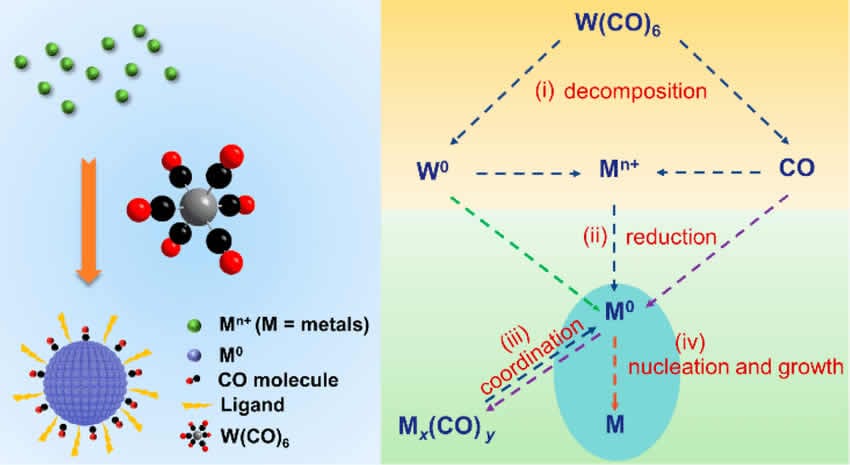
Tungsten hexacarbonyl (W(CO)6) CAS 14040-11-0 and chromium hexacarbonyl (Cr(CO)6) CAS 13007-92-6 are two examples of metal carbonyls, which are compounds composed of metal atoms bonded to carbon monoxide ligands. These compounds have played important roles in the development of materials science and catalysis, and have been used in a variety of industrial applications. However, their use has declined in recent years due to safety concerns and advances in materials science and catalysis. In this article, we will explore the history, usage, and future prospects of tungsten hexacarbonyl and chromium hexacarbonyl.Tungsten hexacarbonyl was first synthesized in 1927 by the German chemist Walter Hieber. Hieber was investigating the reactions of transition metals with carbon monoxide, and found that tungsten reacted with CO to form a volatile compound. He later identified this compound as tungsten hexacarbonyl. The synthesis of chromium hexacarbonyl was also reported by Hieber, along with his colleague Karl Friedrich Bonhoeffer.
Tungsten hexacarbonyl and chromium hexacarbonyl were both found to be useful as precursors for the deposition of thin films of the corresponding metals. This made them valuable in the semiconductor industry, where the ability to deposit thin, uniform films of metal is critical. They were also used as catalysts in a variety of organic synthesis reactions.Tungsten hexacarbonyl has been used in a variety of applications, including the production of tungsten films for use in microelectronics and optoelectronics. It has also been used as a catalyst in organic synthesis, and as a reagent in the production of fine chemicals. In the semiconductor industry, tungsten hexacarbonyl has been used as a precursor for the deposition of tungsten films using chemical vapor deposition (CVD) and atomic layer deposition (ALD) techniques.
Chromium hexacarbonyl has also been used as a precursor for the deposition of thin films of chromium. It has been used in the production of hard coatings for cutting tools, as well as in the production of magnetic storage media. Chromium hexacarbonyl has also been used as a catalyst in organic synthesis reactions, and as a reagent in the production of fine chemicals.Warshel Chemical Ltd under FCAD has scaled up W(CO)6 and Cr(CO)6 to MT scale with 99.99% by ICP-OES analysis of Leeman Prodigy.Tungsten hexacarbonyl partially dissolves in mixed acids and cannot be directly determined by ICP for the tungsten content in the product. Therefore, impurities in tungsten hexacarbonyl are first dissolved out by mixed acids, and the impurity content in the pure tungsten hexacarbonyl is tested by ICP. The purity of tungsten hexacarbonyl is obtained using the impurity reduction method.
The theoretical content of tungsten in tungsten hexacarbonyl is52.23%
The purity calculation of Chromium Hexacarbonyl is similiar.
A-typical-COA-of-Tungsten-hexacarbonyl-WCO6Download
https://www.fcad.com/wco6-and-crco6/
Comments
Post a Comment