- Identification
- Properties
- Safety Data
- Specifications & Other Information
- Links
- Quick Inquiry
Identification
CAS Number
12542-30-2
Name
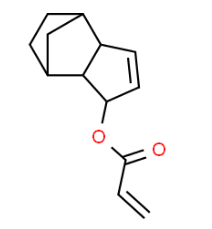
DCPA
Synonyms
12542-30-2 235-697-2 251-678-1 2-Propenoic acid, 3a,4,5,6,7,7a-hexahydro-4,7-methano-1H-inden-1-yl ester 33791-58-1 Acrylate de tricyclodéc-4-én-3-yle Dihydrodicyclopentadienyl acrylateHexahydro-4,7-methano-1H-indenyl acrylateTricyclodec-4-en-3-yl acrylate Tricyclodec-4-en-3-yl-acrylat 3a,4,5,6,7,7a-hexahydro-4,7-methano-1H-indenyl acrylateDicyclopentenyl acrylate
SMILES
C=CC(=O)OC1C=CC2C1C3CCC2C3
StdInChI
InChI=1S/C13H16O2/c1-2-12(14)15-11-6-5-10-8-3-4-9(7-8)13(10)11/h2,5-6,8-11,13H,1,3-4,7H2
StdInChIKey
ISRJTGUYHVPAOR-UHFFFAOYSA-N
Molecular Formula
C13H16O2
Molecular Weight
204.265
Properties
Appearance
Colorless transparent liquid
Density(25°C)
1.050~1.080g/cm3
Safety Data
RIDADR
NONH for all modes of transport
WGK Germany
3
Specifications and Other Information of Our DCPA CAS 12542-30-2
Identification Methods
HNMR, HPLC
Purity
96% min
Viscosity(25°C)
8.0~18.0mPa.s
Acid Value
≤0.5mgKOH/g
Color(Pt-Co)
≤100
Water
≤2000ppm
Inhibitor Content(MEHQ)
300~600ppm
Shelf Life
2 years
Storage
Store at room temperature for long time, sealed and keep in a dry place.
Known Application
- Pressure-sensitive adhesive: Due to its unique monomer structure, it can be used to make pressure-sensitive adhesives, providing good viscosity and flexibility.
- Low volatility substitute: As a low volatility substitute, used to replace other more volatile acrylates.
- Paints and Coatings: May be used in the paint and coatings industry to provide specific physical and chemical properties such as improved adhesion and weather resistance.
- UV curing system: As a reactive diluent in UV curing systems, it is used in applications such as coatings, adhesives and sealants.
- Polymer modification: Used for polymer modification to improve polymer properties, such as elasticity, flexibility and chemical resistance.
- For 3D resin printing and photoresist
Functions that can be played in 3D resin printing:
- Photoinitiator: In light-curing 3D printing, acrylate compounds can be used as a component of the photoinitiator to perform polymerization reactions in response to light of a specific wavelength.
- Viscosity regulator: Adjust the viscosity of 3D printing resin to adapt to different types of 3D printers and printing processes.
- Improve mechanical properties: Improve the mechanical properties of printed objects, such as strength, toughness and flexibility.
- Improve surface quality: affects the surface quality of printed objects, including smoothness and detail performance.
- Increase chemical resistance and weather resistance: Improve the resistance of printed objects to chemical erosion and environmental impact.
Functions that can be played in photoresist:
- Photosensitivity: Acrylic compounds can be combined with photosensitizers to make the photoresist sensitive to ultraviolet or other forms of radiation, thereby forming patterns during exposure.
- Improve adhesion: Improve the adhesion between photoresist and base materials (such as silicon wafers) to ensure accurate transfer of patterns.
- Adjust film properties: Affect the properties of the photoresist film, including hardness, solvent resistance and thermal stability.
- Adjust viscosity and fluidity: Adjust the viscosity and fluidity of photoresist to adapt to different coating and processing technologies.
- Improve resolution: By optimizing the composition of photoresist, the resolution and pattern clarity during micro-machining can be improved.
Links
This product is developed by our R&D company Warshel Chemical Ltd (https://www.warshel.com/).
Quick Inquiry
Fill out our inquiry form and one of our experts will be in touch with you shortly.
https://www.watson-int.com/dcpa-cas-12542-30-2/
Comments
Post a Comment