Related Service Unique Polymer Design, saving millions of dollars for dental customers
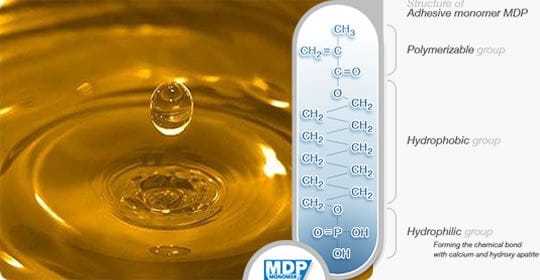
Application MDP (10-Methacryloyloxydecyl dihydrogen phosphate) convinces users by its special monomer structure: This phosphate monomer was extremely effective for enamel, dentin and on metal alloys. Consequently, the material including the MDP monomer, was introduced as a high-performance adhesive resin cement for the cementation to tooth structure and to metals. The impressive success of encouraged many manufacturers to integrate the MDP monomer into other bonding systems as well as to obtain a high degree of adhesion to tooth substrate from the formation of a chemical bonding. MDP is now present in SE Bond, S3 Bond, Protect Bond, Teethmate, Alloy Primer, Ceramic Primer, Porcelain Repair System. Moreover, it remains possible that long-term protection has been provided in the form of the MDPB monomer. It is expected that the product prevents the absorption of bacteria by a change in the surface structure, contributing in the long run to protection from secondary caries. The bonding layer releases small quantities of fluoride to strengthen the neighboring tooth hard structure. A special copolymer aids in preventing shrinkage of the bonding layer and the consequent negative effects on the bond strength.
Synonyms 12-methacryloyldodeylphosphonate; Estenia Opaque Primer; 10-Methacryloyloxydecyl dihydrogen phosphate; Mono-10-methacryloyloxydecyl phosphate; MADDP
CAS Number 85590-00-7 | Molecular Formula C14H27O6P | Molecular Weight 322.33
SMILES O=P(OCCCCCCCCCCOC(=O)C(=C)C)(O)O
StdInChI InChI=1S/C14H27O6P/c1-13(2)14(15)19-11-9-7-5-3-4-6-8-10-12-20-21(16,17)18/h1,3-12H2,2H3,(H2,16,17,18)
StdInChIKey CFKBCVIYTWDYRP-UHFFFAOYSA-N
The related product under development 4-methacryloxyethyl trimellitic anhydride CAS 70293-55-9
Properties of 10-MDP
Structure Analysis
Terminal double bond group for polymerization; Hydrophobic alkylene group to maintain a delicate balance between hydrophobic and hydrophilic properties and hydrophilic phosphate group for performance of the acid demineralization and chemical bonding to tooth structure
Appearance
Light yellow sticky liquid
Flash Point
226.073°C
Boiling Point
450.2°C at 760 mmHg
Density
1.137 g/ml
Description of 10-MDP
Identification Methods
HNMR,HPLC
Purity
95% min
Recommended Storage
2-8°C away from light
Remarks
There is a phenomenon of 10-MDP that is common and will not affect the product’s quality generally that the product may solidify little by little after staying for some time under low temperature.
If liquid form is needed for use, please follow steps below,
1. Put the fluoride bottle with product into thermostat water bath;
2. Set the temperature at 40℃;
3. Wait for 3-4 hours before the product turns liquid again completely.
Productivity
20-30kg/month
Symbol
GHS07
Signal Word
Warning
Hazard Statements
H315-H319-H335
Precautionary Statements
P261-P305+P351+P338
Personal Protective Equipment
dust mask type(N95) US, Eye Shields, Gloves
Hazard Codes (Europe)
Xi
Risk Statements (Europe)
20/21/22
Safety Statements (Europe)
26
WGK Germany
3
10-MDP at Watson Noke
https://www.watsonnoke.com/10-mdp-cas-85590-00-7/
10-MDP at Watson International
https://www.watson-int.com/10-mdp-cas-85590-00-7/
Bonding Agent using our 10-MDP at Polyberg New Material Ltd
https://www.polyberg.com/polyberg-bonding-agent/
https://www.fcad.com/10-mdp/
Comments
Post a Comment